Sourcing
MOQ, lead time and packaging for OEM press-on nails
Three numbers decide whether a launch lands on time and on budget. They are connected, so plan them together.
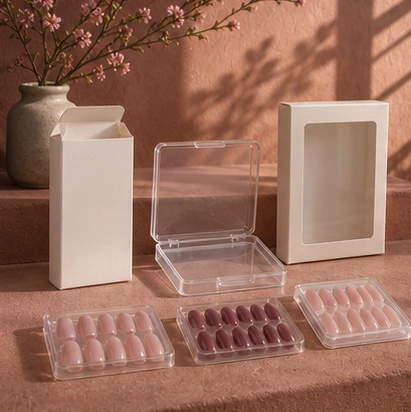
Why the three belong together
A design can meet its minimum and still miss its season because the lead time was underestimated. A box can look perfect on paper and then hold up assembly because the printer has a longer queue and a higher minimum than the nails. Most launch problems come from planning minimum order quantity (MOQ), lead time and packaging separately.
How MOQ works for press-on nails
MOQ is the smallest quantity a factory will produce in one run. For press-on nails it is usually set per design, and sometimes per colourway, rather than per total order. Ask which applies: launching five designs can multiply your total commitment unless mixed designs are accepted.
What pushes minimums up:
- New moulds or shapes, which carry tooling and set-up costs.
- Complex finishes such as 3D relief, applied stones and hand-finished art.
- New colour formulations matched to your references.
- Custom printed packaging, which usually has its own minimum.
What brings them down: library designs, shared shapes and sizes across the range, standard or lightly branded packaging, and fewer SKUs at launch. Our MOQs are low and quoted per project, so tell us your estimated quantity per design in the quote brief.
Product MOQ versus packaging MOQ
A printed box, foil-stamped sleeve or branded insert often has a higher minimum than the nails themselves. If your first order is smaller than the packaging minimum, consider:
- the factory’s standard packaging with a branded sticker or sleeve;
- neutral packaging shared across several SKUs, with a printed insert per design;
- moving to fully custom boxes once volumes are proven.
Lead time, stage by stage
| Stage | What happens | Our typical timing |
|---|---|---|
| Brief and file set-up | Artwork, colours, shape and kit agreed | Depends on how complete the brief is |
| Sample | A physical set to judge shape, colour and finish | 3 to 15 days |
| Revisions | Changes and re-sampling until approval | Depends on the changes |
| Production | Shaping, finishing, colour matching | 30 to 45 days after approval |
| Packing and inspection | Kit assembly, final inspection, cartons | Planned into the production schedule |
| Shipping | Air or sea freight, customs | Depends on method and destination |
The stages that most often slip are on the buyer side: late artwork, slow sample feedback and changes after approval. Factory workload also rises before peak seasons and around the Lunar New Year holiday in China, so book production early for autumn and holiday launches.
Planning a launch backwards
- Fix the date the stock must be in your warehouse.
- Subtract shipping time for your chosen method, plus customs.
- Subtract production, packing and inspection.
- Subtract sampling and at least one round of revisions.
- Add a buffer of one to two weeks for the unexpected.
Ask for a written schedule with dates for sample delivery, production start, completion and handover to the carrier.
Choosing packaging
| Type | Good for | Trade-off |
|---|---|---|
| Bulk trays or polybags | Wholesale, salon use, internal kitting | Not retail-ready |
| Standard factory packaging | Fast launches, test orders | Less brand presence |
| Custom branded packaging | Retail shelves, gifting, premium positioning | Higher minimums, longer lead time |
Common formats include card sleeves with a plastic tray, clamshells, rigid boxes with magnetic closure, kraft or recycled board, and printed inserts for glue, prep pads and instructions. For e-commerce, choose packaging that is light, protective and photographs well. For high-shine and 3D designs, choose trays that hold every nail apart.
Keeping nails and packaging in step
- Confirm packaging specifications during sampling, not after approval.
- Sample the nails in the actual packaging and ship it to yourself.
- If packaging comes from another supplier, align delivery dates to the factory’s packing date.
- Keep the first launch simple; refine packaging as sales data arrives.
Separate the box decision from the design decision
A packaging minimum can strand cash even when the factory can make the tips in a smaller run. In this example three designs share one retail box. All quantities and prices are planning assumptions.
| Checkpoint | Calculation or evidence | Buying decision |
|---|---|---|
| Demand | 3 designs × 240 sets = 720 saleable sets. | Keep the design mix independent of the carton print run. |
| Printed inventory | A printer offers 1,200 boxes at $0.40 each. After filling 720, 480 remain. | $192 of the print spend sits in unused packaging. |
| Artwork control | A change to piece count or pack wording could make the remaining boxes unusable. | Get written approval on the box revision before printing. |
Compare a common box with variable sleeves against separate printed boxes per design. Before changing a retail pack, check the GS1 rules for identifying a changed trade item with the retailer. Ask where leftover packaging will be held and who pays for storage.