Sourcing
Scaling press-on nail production: how brands manage large-volume manufacturing
A design that sells out at small volume can fall apart at scale if quality, forecasting and packaging do not grow with it. Here is what changes and how to prepare.
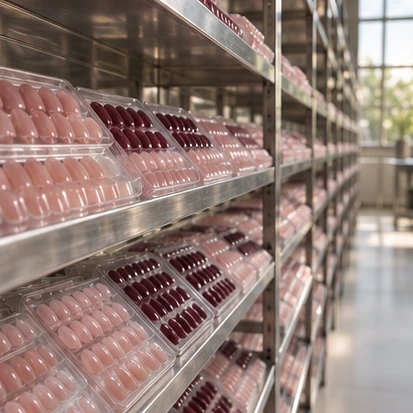
From small runs to volume
Many press-on brands start with small batches, sometimes partly hand-finished. Growth changes the economics: unit costs fall with volume, but only if the product can be made the same way every time. Scaling is less about bigger orders than about turning a good sample into a repeatable process.
Three capabilities make that possible:
- Moulded tips in a stable size system, so fit is identical across runs.
- Process-controlled finishing: measured colour, controlled curing, documented techniques for each effect.
- Statistical inspection against an approved standard, instead of checking by eye.
Milestones before volume production
- Approved golden sample for each design, signed off and kept by both sides.
- Written specification: shape, sizes, material, colour references, finish, kit and packaging.
- Defect list and inspection plan agreed before the first run.
- Packaging tested in real shipping conditions.
- A pilot run or first order sold through before the big commitment, where possible.
Forecasting, MOQs and lead times at scale
At volume, the question shifts from “what is the minimum?” to “how do we never run out?” Share a rolling forecast with the factory so materials and production slots can be reserved. Split best-sellers into regular replenishment orders and treat new designs as separate, smaller launches. Production after approval usually runs 30 to 45 days with us, so reorder points must cover production plus shipping plus safety stock. Seasonal peaks need earlier booking. The basics are in MOQ, lead time and packaging.
Quality control and risk
AQL (acceptance quality limit) sampling inspects a defined number of units from a batch and accepts or rejects the batch based on the defects found. Defects are classed as critical (safety), major (function or obvious appearance) and minor (small cosmetic flaws), each with its own limit. Agreed limits turn quality disputes into measurements.
A scalable quality system also includes batch coding so any complaint can be traced to a production date and materials, retained samples from every batch, and a corrective action log that shows what changed after a problem. Read the quality control guide for market-specific documents.
Cost and margin management
- Standardise shapes and sizes across the range to cut mould and packaging variety.
- Use shared packaging with design-specific inserts or labels.
- Reserve expensive techniques for hero designs; let simpler designs carry volume.
- Consolidate shipments, and compare air and sea on total cost including stockouts.
- Track returns by reason; fit and adhesion issues are usually cheaper to fix in the specification than in customer service.
Customisation at scale
Scale does not have to mean sameness. Seasonal colourways on proven shapes, limited editions in the same packaging system and ODM refreshes of best-sellers keep a range current without restarting development. Plan the calendar so new designs are sampled while current ones are in production.
Choosing a high-volume partner
- Can the factory show capacity for your peak months, not just average months?
- How are colour and finish matched from run to run?
- Will they work to your inspection plan and accept third-party inspection?
- Can they hold materials or production slots against a forecast?
- How do they handle a design change mid-season?
Our stated maximum capacity is 1,000,000 sets a month. More useful for planning is the schedule we confirm for your order after sample approval.
Starting volumes for new brands
A larger first run lowers unit cost, but unsold stock ties up cash. A focused launch of two or three designs at meaningful volume usually beats a wide launch of many designs at minimum quantities. It concentrates marketing, simplifies packaging and gives clearer sales data for the second order.
Set a reorder point and test its sensitivity
Suppose a brand sells 16 sets per day, expects 45 days between release and saleable stock, and wants 12 days of buffer. This is a planning model, not a promised lead time.
| Checkpoint | Calculation or evidence | Buying decision |
|---|---|---|
| Base trigger | 16 × (45 + 12) = 912 sets. | Review inventory position: available plus confirmed inbound less committed orders. |
| Launch uplift | At 22 per day the same cover requires 1,254 sets. | A 38% demand increase moves the trigger up by 342 sets. |
| Receiving check | Track accepted and rejected units by lot, finish and defect type. | A rising reject rate reduces saleable cover even if shipped quantity stays constant. |
Agree the lot acceptance sampling plan separately from your reorder calculation. A passed sample does not measure every unit; compare returns from consecutive releases before changing production speed.