Sourcing
OEM press-on nails lead time
A dated timeline from brief to delivered stock, with transit options and the delays that push launches back.
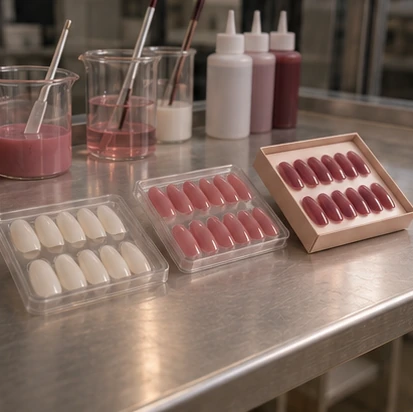
Separate approval time from production time
Start with the date the receiving warehouse needs saleable sets. A launch date is too late if stock still needs inspection, product photography and allocation. Put one owner beside every handoff. Ask the factory whether the quoted clock counts calendar or working days and what starts it: receiving artwork, a deposit, or sample approval.
| Milestone | Dependency | Working scenario |
|---|---|---|
| Physical sample | Final artwork, shape reference and material choice | 12 days in this example |
| Buyer approval | Fit check and signed artwork version | 4 days |
| Production | Approved reference and confirmed components | 38 days |
| Transit and receiving | Booked route and warehouse appointment | 14 plus 3 days |
Build a date that can survive a revision
The illustrative critical path above totals 71 days. A seven-day sample revision extends it to 78 if everything else waits. A packaging task can run in parallel once the tray dimensions are fixed, but printing a sleeve before finalising the adhesive or piece count creates rework. Compare this model to Orla’s stated sample range of 3 to 15 days and production range of 30 to 45 days after approval. Confirm transport separately.
Know which delivery event the quotation covers
A dispatch date and an in-warehouse date describe different events. Write the named place and the agreed rule beside the date. The ICC explains which transport and clearance responsibilities change between EXW and DDP. Ask the forwarder about the actual kit, including adhesive and liquids, before accepting a schedule.
Control the release
Request a dated critical path with an owner for sample approval, packaging proof, production release, inspection booking, carrier handover and receipt. Give each owner one fallback: delay the launch, release fewer styles, or use an approved packaging alternative. An unapproved substitution is never a scheduling shortcut.
Which delay changes the launch date?
Use a dependency table for an illustrative launch whose first production slot is already reserved. Ask the supplier which dependencies really prevent work from starting and which can run together.
| Checkpoint | Calculation or evidence | Buying decision |
|---|---|---|
| Late design approval | Approval slips from day 16 to day 20. If production cannot start before approval, four days are added. | Move ship and receipt dates together and keep the original date visible for variance reporting. |
| Parallel carton work | A box proof due on day 18 slips two days. The first insertion of kits into boxes is scheduled for day 36. | If no material order or upstream job depends on that proof, those two days use buffer without moving the delivery date. |
| Failure at inspection | The sample packing map calls for 12 sizes. A repeated size in the last pair would require opening and checking affected sets. | Reserve a reinspection point. Record how many sets can be released and which lots remain held. |
If the pack size or contents change, check the trade-item identification rules before printing labels. Hand the forwarder actual outer dimensions, carton count and component list. At the warehouse, confirm whether an appointment is needed, who makes it and how much time is required between delivery and the first retailer dispatch.