Materials, shapes and styles
Nail shapes guide for press-on nail collections
Shape decides how a design reads, how a set fits and who it is for. How to choose shapes, lengths and set sizes for a range.
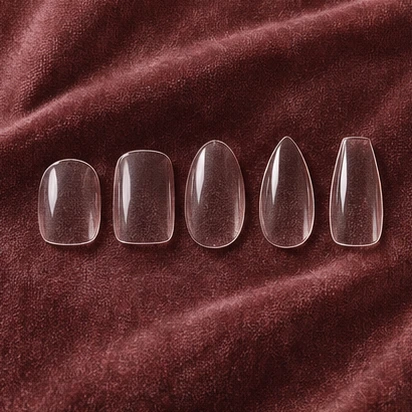
Why shape matters
The same design looks quiet on a short oval and dramatic on a long coffin. Shape also decides fit, comfort, how strong the tip needs to be and how the set is packed. Choose it as deliberately as colour.
Shape families
| Shape | Look | Role in a collection |
|---|---|---|
| Short square | Clean, practical | Everyday and work-friendly line |
| Round | Natural, soft | Beginner-friendly line |
| Oval | Elegant, wearable | Core line |
| Almond | Refined, lengthening | Premium and fashion line |
| Coffin or ballerina | Bold, trend-led | Fashion and social line |
| Squoval | Neat with soft corners | Daily line |
| Long tapered or stiletto | Dramatic, editorial | Statement and campaign line |
Our standard shapes are almond, oval, square, coffin and squoval, and other shapes can be developed on request. You can set any of the five in the sample book.
Length positions the product
- Short: everyday, office, first-time press-on wearers, toe sets.
- Medium: mainstream fashion, the broadest audience.
- Long: statement, occasion and campaign looks; needs a stronger tip and protective packaging.
Set size: 24 or 30 pieces
Our sets come as 24 pieces in 12 sizes or 30 pieces in 15 sizes. A 24-piece set is compact and retail-friendly. A 30-piece set gives more sizes, so more customers find a close fit, which reduces mismatched nails and returns. Other piece counts are common in the market; choose by your customers’ fit needs and your packaging.
Matching shapes with designs
- French tip: short almond, squoval and square.
- Cat eye and chrome: almond and coffin show the reflection along a longer surface.
- 3D relief: medium to long almond or coffin with enough surface and a stronger tip.
- Japanese style: short to medium almond and oval.
- Solid colour: any; let the colour story decide.
Building a shape mix for a collection
Start with one or two shapes across the whole launch. It keeps sizing consistent, simplifies packaging and lets customers reorder with confidence. A common pattern is one wearable shape (short almond or squoval) for core designs and one fashion shape (coffin or long almond) for statement designs. Add shapes when sales data shows demand.
Check before you confirm a shape
- Does the curve sit flat on narrow and wide nail beds?
- Is the free edge thin enough to look natural but strong enough not to crack?
- Do the smallest and largest sizes look like the same design?
- Does the shape fit your packaging tray?
How shape affects sampling and production
Library shapes use proven moulds and sizing, so samples are faster and minimums lower. New shapes need new moulds and a fit trial. Decide shapes early: changing shape after design approval usually means re-sampling.
Decide whether another shape deserves shelf space
Separate width, length and outline in the size chart. Changing one can change the fit even when the two products share a marketing name.
| Checkpoint | Calculation or evidence | Buying decision |
|---|---|---|
| Range size | 4 finishes × 3 shapes × 2 lengths = 24 SKUs. | Adding one shape at both lengths adds eight SKUs before you change colour. |
| Test batch | At 20 trial sets per SKU, the original range uses 480 sets. The expanded range uses 640. | Decide whether the additional 160 sets will answer a specific fit question. |
| Size-level results | Record the best-fit size and unmatched fingers rather than only an overall comfort score. | Expand widths if width is the problem; adding length cannot fix it. |
When changing a marketed set configuration, compare it with the GS1 criteria for assigning a new trade-item identifier. Maintain the mould reference and measurement method behind each size name for later reorders.