Materials, shapes and styles
Best-selling press-on nails in the US: what the list shows and how to build a range from it
A dated look at the US press-on best-seller list, what shoppers searching for the “best” or “handmade” sets are actually choosing, and how a brand turns that into anchor, social and statement designs with a price plan.
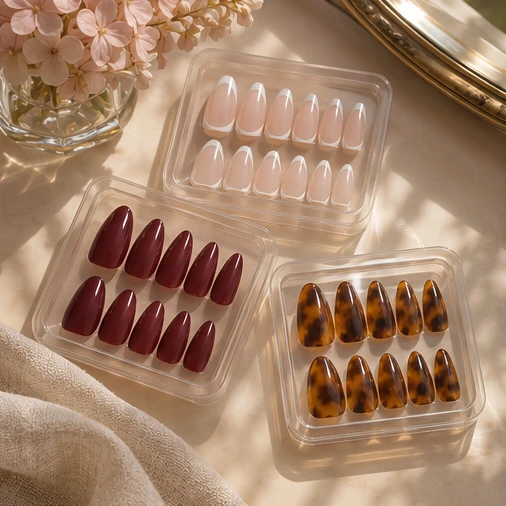
How to read this guide
This page serves two readers. Shoppers searching for the best press-on nails want to know which styles, lengths and kits are popular and what “handmade” really means. Brand owners and marketplace sellers want to know what to put in a range. Both start from the same evidence, so we show it first and say plainly what it can and cannot tell you.
The main evidence is a snapshot we took of Amazon’s US best-seller list for press-on false nails at about 14:33 UTC on 17 November 2026. Amazon describes that list as its most popular products based on sales, updated frequently. A rank is a position relative to other listings at one moment. It is not sales data: it gives no units, no revenue and no history, and a listing can move many places in a day. Read it as a picture of what was winning attention in mid-November, the start of the US holiday season, not as a forecast for your brand.
What the best-seller list showed on 17 November 2026
We read the titles of the top 50 listings in the press-on false nails category, as seen by a logged-out visitor in the US store. Sellers write their own titles, so a title can omit the shape or length; the counts below are what the titles say, not what we measured on the product. Prices were not displayed to a logged-out page load (each tile read “Click to see price”), so we did not record a price band and we do not quote one.
| Attribute | What the 50 titles said | What it suggests for a range |
|---|---|---|
| Length | 44 mention short (15 of them extra, super, ultra or petite short); 3 say medium; none say long | Short is the default for everyday sets; long belongs in a small statement tier |
| Shape | Almond 14, square 14, squoval 10, oval 5, round 2, coffin 0; the rest did not state a shape | Two library shapes, one soft (almond) and one squared (square or squoval), cover most of the list |
| Design | French in 15 titles; red, burgundy, wine or berry in 14; pink in 11; nude or milky in 9 | French and red-family shades were both visible in this November snapshot |
| Effects | Cat eye, magnetic or velvet in 6; glitter, rhinestones, charms or pearls in 9; chrome in 2; ombré in 1 | Effects sell as accents to a core, not as the core |
| Season words | “Fall” in 13 titles, “Christmas” in 10 | Seasonal naming is common even on evergreen colours |
| Pack count | 32 pieces in 23 titles (usually with 16 sizes); 30 in 7; 24 in 4; one each of 20, 36 (toe) and 42; 6 bulk tip packs from 72 to 576 pieces | Shoppers expect a full kit with enough sizes to fit; size count is a selling point |
| Application | 8 titles sold no-glue or peel-and-stick sets; 7 mentioned gel or soft gel | Adhesive choice and finish claims are part of the offer, not an afterthought |
| Other segments | 3 kids’ sets and 2 toe sets reached the top 50 | Niche lines can sit beside the main range once the core reorders |
Method: one page load, top 50 ranks, US store, logged out, 17 November 2026. Counts overlap (a title can be both French and almond). We name no brands because the point is the pattern, not who held which rank. Repeat the snapshot yourself before you commit volume; the method is at the end of this guide.
What this means if you are shopping for the best press-on nails
If you came here as a shopper, the list points to a few practical choices that matter more than any single brand:
- Start short. Short almond, square and squoval sets dominated the list. Short tips are easier to apply, catch less on daily tasks and are kinder to first-time wearers.
- Check the size count. Piece count and size count are different. Ask how many distinct widths the pack includes. More sizes mean a better chance that each nail sits edge to edge without filing.
- Look at what is in the kit. Glue for longer wear, adhesive tabs for short wear and easy removal, a file, a cuticle stick and a prep pad. Peel-and-stick sets trade some wear time for speed.
- Choose a finish you will not tire of. French, nude and milky sets topped the list for a reason: they go with everything and suit repeat wear. Save cat eye or 3D sets for events.
“Handmade” press-on nails: what the word should mean
Searches for handmade press-on nails are common, and the word is used loosely. On Amazon, the Handmade store defines handcrafted items as “made by hand using raw materials”, and admits makers through an application and audit process. Most press-on sets sold in volume are made in factories: tips are moulded, then coloured and decorated by a mix of machine and hand steps. Fine line work, 3D gel, charms and rhinestones are often placed by hand; flat colour and printed patterns usually are not.
For a brand, the rule is simple. US law requires that advertising be truthful and non-deceptive, and that advertisers have evidence to back up their claims. If a set has hand-painted details, say “hand-painted details” and keep a record of which steps are done by hand. Do not call a factory-made set “handmade”. Ask your manufacturer which steps are manual for each design and keep that answer in your product file.
What category data says, and what it does not
Category data on press-ons is thin in public. NielsenIQ reported in March 2023 that artificial nails had passed nail polish in quarterly sales in late 2022, after several years of faster growth. Its February 2026 report on US press-ons is sold rather than published; the report listing describes press-on buyers spending more than traditional polish users, with Gen Alpha emerging as the most engaged users. Neither public page gives a figure we can quote, and both cover artificial nails broadly, not press-on nails alone. We found no primary Circana release with nail-specific numbers.
What that means in practice: there is no reliable public number for “how many press-on sets sell in the US”. Market-size figures you see on blogs vary widely and rarely show a method. Build your plan from your own channel data and from repeated snapshots like the one above, and treat third-party totals as background at most.
From snapshot to range: anchor, social and statement designs
A range that reorders well has three jobs, and each design should have one of them. The table turns the snapshot into roles.
| Tier | Job | Typical designs | Shapes and length | Share of designs at launch |
|---|---|---|---|---|
| Anchor | Reorders all year; carries the brand | Classic and micro French, milky white, nude pink, sheer pink, solid red; see French tip and solid colour styles | Short almond and short square or squoval | About half |
| Social | Stops the scroll; drives video and new customers | Burgundy or berry cat eye, pearl or chrome glaze, soft gradients | Same two shapes; one may run slightly longer | About a third |
| Statement | Seasonal or event sets; lifts the average order | 3D charms, rhinestones, holiday art, longer almond or coffin | Medium to long; one shape only | The remainder, rotated each season |
Two shapes are enough at launch. Every extra shape multiplies sizing, packaging inserts and stock, and the snapshot shows that short almond and short square or squoval already cover most of what sells. See the shapes guide for lengths and fit.
Price architecture
Because the snapshot did not show prices, the price points below are assumptions for a worked example, not observed market prices and not ORLA prices. Replace every number with your own quotes and channel fees before you decide anything.
| Tier | Assumed retail price | Assumed landed cost per set | Assumed channel costs (30% of retail) | Contribution per set |
|---|---|---|---|---|
| Anchor | $12.99 | $2.40 | $3.90 | $6.69 |
| Social | $15.99 | $3.10 | $4.80 | $8.09 |
| Statement | $19.99 | $4.20 | $6.00 | $9.79 |
The 30% channel figure is a placeholder that bundles marketplace fees, fulfilment and advertising; check your own marketplace’s current fee schedule. Landed cost means the factory price plus packaging, freight, duty and inbound handling. Two lessons survive any change in the numbers: price steps should be big enough that a shopper sees why the statement set costs more, and the anchor tier must still make money after advertising, because it is the tier you reorder most.
Pack size, sizing and kit
The list showed that shoppers expect a complete kit and a generous size run. ORLA sets come as 24 pieces in 12 sizes or 30 pieces in 15 sizes, with a standard kit of glue, adhesive tabs, a wooden stick, a file and an alcohol pad; contents can be specified. Choose the 30-piece, 15-size set when fit is your selling point or your customers have very narrow or very wide nails; the 24-piece set suits gift and travel packs. State the piece count and the number of sizes on the front of the pack and in the listing title, because that is how shoppers compare.
Worked range plan: a 12-design US launch
Example brand, fictional: Northline Nails, selling on Amazon and its own site, launching for Mother’s Day on 9 May 2027.
Range (12 designs): 6 anchor (classic French, micro French, milky white, nude pink, sheer pink, solid cherry red), 4 social (burgundy cat eye, pearl glaze, pink chrome, nude-to-white gradient), 2 statement (pearl and rhinestone French in medium almond, floral 3D in short square).
Shapes: short almond and short square only; statement almond at medium length.
Assumed first-order split: 600 sets per anchor design, 400 per social design and 250 per statement design, 5,700 sets in all. These are the brand’s assumptions; minimums are quoted per design and packaging.
Timeline: brief by 11 January 2027; samples 3 to 15 days after the brief, depending on complexity; allow a second round for the 3D design; production 30 to 45 days after sample approval; shipping planned separately. With approval by mid-February, production ends by early April at the latest, leaving about a month for freight and marketplace receiving.
After launch: reorder anchors on sell-through; replace the weaker social design after eight weeks; swap the statement pair for a summer set.
Mistakes to avoid when copying a best-seller list
- Copying the season, not the style. A November list is full of burgundy and “fall” sets. Launching those in March means fighting the calendar. Take the shapes, lengths and kit standards from the list; take the colours from the season you will actually sell in.
- Copying one listing. A single top listing may be there because of a deal, a creator video or years of reviews. Patterns across many listings are the useful signal.
- Too many shapes and lengths. The list was overwhelmingly short. Adding long coffin “for choice” spreads stock thin for little gain at launch.
- Ignoring the kit. Pack count, size range and adhesive options appear in almost every top title. A strong design in a thin kit will lose on comparison.
Take your own best-seller snapshot
- Open the category list in the marketplace you sell on, logged out, and record the date, time, store and category path.
- Copy the top 50 titles, and record price and rating count if they are shown.
- Code each title for length, shape, design, effect, pack count and adhesive. Keep a column for “not stated”.
- Repeat weekly for at least six weeks, across a season change. A style that holds its place across weeks matters more than a single high rank.
- Compare with your own sessions, conversion and returns. Your data decides the second order; the list only shapes the first.
Next steps
For a private label range, start with the private label service; for designs built from your own brief, see ODM. Pick finishes from the sample book, then read how sampling works and send a brief through the contact page. Selling mainly through video? Read OEM press-on nails for TikTok Shop sellers. Colour-led ranges have their own guides: pink and red.