Colour and design trends
Red press-on nail collections: families, timing and the discipline that keeps a red consistent
Red is simple to brief and hard to repeat. This guide sorts reds into families, matches them to the US selling calendar and to finishes, explains how to hold a red steady from sample to reorder, and plans a drop backwards from the date it must be on sale.
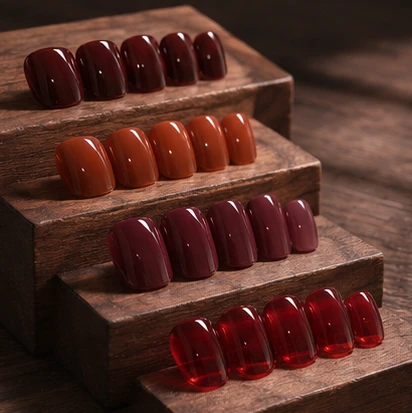
Red families
“Red” on a brief is not a specification. Most red ranges are built from four or five families, separated by which way the red leans and how dark it is.
| Family | Lean | Depth | Mood and use | Finishes that suit it |
|---|---|---|---|---|
| Classic red | Balanced, neither blue nor orange | Medium | The evergreen red; holiday and Valentine’s anchor | High-gloss cream, red French tip |
| Cherry | Blue-leaning | Medium to deep | Glamorous, cool; flatters many skin tones | Jelly, gloss, chrome |
| Tomato and coral red | Orange-leaning | Bright | Summer and Fourth of July | Gloss cream, short square |
| Brick and rust | Brown-orange | Medium, muted | Autumn, minimal and fashion-led ranges | Matte or satin, velvet cat eye |
| Burgundy, wine, oxblood | Blue-brown | Deep | Autumn and winter, evening | Cat eye, glitter, gloss over a dark base |
A balanced red collection usually holds one classic, one cherry and one deep red, then adds a brick in autumn or a tomato in summer. Two reds of the same family and depth in one drop will split each other’s sales.
What was selling in mid-November
Our snapshot of the US press-on best-seller list on 17 November 2026 found 14 of the top 50 titles naming red, burgundy, wine, cranberry, berry or maroon. Most were short almond, oval, squoval or square sets in gloss, with cat eye, glitter and one red chrome among them, and many titles carried “fall” or “Christmas” in the name. That is one moment at the start of the holiday season, and a rank is not sales data; the US best-sellers guide explains the method. What it does show is that deep and classic reds are expected on the shelf by mid-November, so they must be produced well before.
The US selling calendar for red
Red has more selling windows than any other colour in the US calendar. Two of them are measured by the National Retail Federation, though neither figure is about nails: they show how much spending each window carries, not what share goes on press-ons.
- Winter holidays. NRF defines the season as 1 November through 31 December and forecast 2026 holiday retail sales of $1.013 trillion, up 4.2% on 2025 (forecast published 15 October 2026).
- Valentine’s Day. NRF and Prosper Insights projected a record $29.1 billion in Valentine’s Day spending for 2026, from a survey of 7,791 adults in early January 2026.
| Window | Date | Reds that fit | Stock on sale by (planning target) |
|---|---|---|---|
| Autumn and Halloween | 31 October | Brick, burgundy, dark cherry; matte and velvet | Early September |
| Thanksgiving and holiday | 26 November 2026; season runs to 31 December | Classic, cherry, burgundy; glitter, chrome, cat eye | Early October |
| Valentine’s Day | 14 February | Classic and cherry; red French, hearts as accent nails | Mid-January |
| Fourth of July | 4 July | Tomato and classic red with white and blue accents | Early June |
The “on sale by” column is a planning assumption, not a rule: it allows for listing, reviews and paid media to warm up before the peak. Shorten or lengthen it for your own channel.
Finish pairings that turn a red into a collection
A collection is one red family told through several finishes, so a shopper can buy the look that suits the occasion.
- Gloss cream and jelly. The base of any red range; see solid colour. Jelly cherries look rich but show any unevenness in the tip.
- Red French. A sheer or milky base with a red tip, or a red base with a fine gold line; see French.
- Cat eye and velvet. Burgundy and wine are natural cat eye bases; the moving band reads as depth rather than sparkle. See cat eye and the magnet ring for refreshing the effect.
- Chrome. Red chrome over a dark base makes a strong holiday statement; see glaze and chrome.
- 3D accents. One or two accent nails with gold studs, bows or hearts lift a classic red set for holidays; see 3D.
Keep the red identical across the finishes in a collection where the base shows. That is where colour discipline starts to matter.
Naming reds so they stay distinct
Give every red a name that tells the shopper its lean and depth (“cherry gloss”, “brick satin”, “wine cat eye”) and use the same name on the brief, the master sample label, the pack and the listing. A shared name list prevents the common reorder mistake in which “our red” means one shade to the brand and another to the factory.
Colour matching discipline
Red is unforgiving. A small shift in a deep red reads as a different colour, and a red that matched at sample can drift at reorder if the reference was a screen colour. Three tools keep it steady.
1. A physical master sample
Approve a painted master tip for each red, sign and date it, and keep one at the factory and one with you. Every later sample, production lot and reorder is judged against that master, not against a photo. Keep the master away from sunlight and heat between uses.
2. A reference standard, specified exactly
A Pantone code is a useful shared language, but only with its suffix, because the same number exists on different physical editions. Pantone itself notes that it replaced the TPX suffix with TPG in 2015, reformulating the colours to match while keeping the names and numbers. Write the full code and edition on the brief and approve against the same physical guide on both sides. Treat the Pantone chip as the target and the approved nail master as the standard, because a lacquered nail tip will never look exactly like paper or cotton.
3. Measured colour difference (delta E), used correctly
Delta E is a number for how far apart two colours are. The current international formula is CIEDE2000, defined in ISO/CIE 11664-6, now in its 2022 edition. It works from CIELAB measurements and, in the CIE’s words, is an extension of the 1976 formula with corrections for how perceived colour difference varies with lightness, chroma and hue. Three points matter for buyers:
- There is no universal pass mark. The standard defines how to calculate the difference, not what tolerance is acceptable. Agree a tolerance with your supplier on the approved master, and state the formula (CIEDE2000, not the older CIE76), the instrument and the illuminant.
- Measure what the formula is for. The CIE describes the standard as covering colours perceived as reflecting or transmitting objects, and not areas that appear to be specularly reflecting light. Mirror chrome and strong cat eye effects are therefore judged visually against the master, not by delta E.
- Look as well as measure. Check every red under daylight and warm light. The CIE defines D65 to represent average daylight and illuminant A to represent tungsten-filament lighting; two reds that agree under one can split under the other.
| Stage | What is compared | Who signs off |
|---|---|---|
| Brief | Pantone code with suffix, colour name, physical reference if you have one | Brand |
| Sample | Painted tips against the reference, under daylight and warm light | Brand approves; master tips signed and split |
| Production | Lot tips against the master, visually, and by delta E where agreed | Factory checks before packing; ORLA inspects every order before packing |
| Reorder | New lot against the same master, not against the last lot | Brand and factory |
The quality page explains the inspection steps, and the quality control guide covers sampling plans.
Length, shape and the wearer
Red is the colour that most changes the character of a shape. A short square in classic red looks polished and practical; the same red in a medium almond looks evening-ready. Deep reds and burgundies look most refined short, where the colour reads as depth rather than weight; long red sets belong in the statement tier. Test each red on a range of hands before you approve: blue-leaning cherries and orange-leaning tomato reds can look very different from one skin tone to the next, and a red that looks balanced on the designer’s hand may read orange or purple on a customer’s. The pink guide sets out a simple test-panel method that works for red too.
Production checks for red sets
Dark, saturated colours show different faults from pale ones. Add these to the approval notes for every red design.
- Coverage at the free edge. Where colour thins at the tip edge, a pale line shows; deep reds make it obvious. Check the edge of every size.
- Streaks and pinholes. Cream reds show brush marks; glossy deep reds show pinholes and dust under the top coat. Look under a single bright light at an angle.
- Lot-to-lot shift. Compare each production lot with the master, not with the previous lot, so small drifts do not add up across reorders.
- Effect consistency. For cat eye, check that the band sits in the same place across all ten nails; for glitter, that density is even from thumb to little finger.
- Packaging contrast. Red packaging behind red nails can make the product hard to see in a thumbnail. A neutral tray or a window that frames the nails usually photographs better.
Worked drop plan: a red Valentine’s drop, honestly timed
Example brand, fictional: Ember Lane, selling on TikTok Shop and its own site, briefs a five-design red drop on 24 November 2026.
Designs: classic red gloss (short almond), cherry jelly (short square), red micro French (short almond), burgundy cat eye (short squoval), and one statement set with two heart accent nails (medium almond).
Samples: 3 to 15 days, so ready by 9 December at the latest; Ember Lane approves within five days, by 14 December.
Production: 30 to 45 days after approval, so complete between 13 and 28 January 2027.
Freight (assumption): 5 to 10 days by air to the brand’s own warehouse, plus a few days to receive.
Result: at the fast end, stock lands in late January and the drop works for Valentine’s Day on Sunday 14 February 2027. At the slow end, stock lands in early February, too late for a marketplace warehouse and paid media to warm up. Factory holidays around Lunar New Year can also fall in this window; confirm closure dates when you book.
Decision: keep the Valentine’s drop to the four simplest designs, ship by air to the brand’s own warehouse, and move the heart statement set to the holiday 2027 collection. For holiday 2027, work backwards from an early October on-sale date: freight in August, production in July, sample approval by early July, brief in June.
Next steps
Pick red bases and finishes from the sample book, then read how sampling works before you set dates. Send your red families, Pantone references and target on-sale date through the contact page. For your own designs and artwork, see OEM; for timing detail, read the lead time guide. Building a softer story as well? See pink press-on nails.