Colour and design trends
Pink press-on nails that sell: undertones, finishes and a capsule that holds together
Pink is a family, not a colour. This guide covers how undertone and opacity change a pink on different hands, which finishes carry it, how to split a pink capsule into designs a shopper can tell apart, and how to approve samples under more than one light.
Why pink needs a system
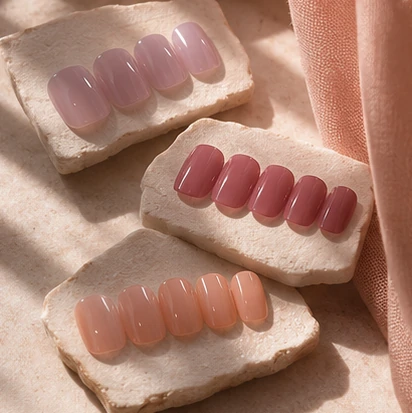
Pink sells in every season, which is exactly why pink ranges go wrong. A brand adds a ballet pink, then a milky pink, then a nude pink, and ends up with five designs that look the same in a thumbnail and compete with each other. The fix is to decide in advance what separates one pink from the next: undertone, opacity, finish and shape.
Pink is not only a spring story. In our 17 November 2026 snapshot of the US press-on best-seller list, 11 of the top 50 titles named pink, in the middle of a list otherwise led by autumn and holiday reds. Most were quiet pinks: nude pink, milky pink, sheer pink and pink-based French, with a little pink chrome and glitter. The US best-sellers guide explains that snapshot and its limits; a best-seller rank is not sales data.
Undertones: the first split
Every pink leans somewhere. Naming the lean on the brief stops two designers, or a designer and a factory, from picturing different colours.
| Pink family | Undertone | Typical opacity | Where it fits |
|---|---|---|---|
| Ballet or sheer pink | Cool to neutral | Sheer; the natural nail and free edge show through | Everyday, bridal, base for French and line art |
| Milky pink | Neutral, softened with white | Semi-opaque, cloudy | Clean-girl and office looks; the most forgiving on fit gaps |
| Peach or nude pink | Warm | Semi-opaque to opaque | Neutral sets meant to look like a healthy natural nail |
| Rose and dusty mauve | Cool to neutral, greyed | Opaque | Autumn and winter pinks; pairs with cat eye |
| Bubblegum and baby pink | Cool | Opaque | Youthful, playful and kids’ lines |
| Hot pink and fuchsia | Cool, high chroma | Opaque or jelly | Summer, party and statement sets |
A useful rule: no two designs in one capsule should share both the same undertone and the same opacity. If they do, one of them needs a different finish or a different shape, or it should go.
Skin tones: test on more than one hand
Sheer and milky pinks are partly transparent, so the wearer’s nail bed and skin become part of the colour. A peach-nude that reads as natural on a light hand can look chalky on a deep one; a cool ballet pink can turn grey on an olive hand. The only way to know is to try the sample on real hands.
Build a small test panel that spans light to deep skin. Google’s Monk Skin Tone Scale, a 10-shade scale developed with Harvard sociologist Dr Ellis Monk and released openly for anyone to use is a practical way to make sure your panel is not clustered at one end. Photograph each sample on at least three hands from different parts of the scale, in the same light, and judge the set as a capsule: a good pink range has at least one nude-pink that reads natural on each hand in the panel.
- For warm and olive hands, check that cool pinks do not turn grey or ashy.
- For deep hands, check that milky and pastel pinks do not look chalky; a richer peach-pink or a rose may do the nude job better.
- For light hands, check that hot pinks and fuchsias do not overwhelm a short shape.
Finishes that carry pink
The finish does as much as the colour. Each one below is built differently on a tip, and each has a different thing to check at sample stage.
| Finish | How it reads | What to check on the sample | ORLA style page |
|---|---|---|---|
| Jelly | Tinted and translucent, glossy | Bubbles, streaks and uneven thickness show through; check the tip is clear and the colour even from cuticle to edge | Solid colour |
| Milky | Soft, cloudy, semi-opaque | Opacity depends on layer thickness; agree the number of coats so reorders match | Solid colour |
| Glazed or pearl | Pink base with a pearly sheen | Sheen should be even across all 10 nails; look at an angle under a single light | Glaze |
| French with pink base | Sheer or milky pink with a white or coloured tip | Smile line symmetry across sizes; the base must not shift colour between sizes | French |
| Chrome | Mirror-like pink metal | Scratches and fingerprints; the coating must not lift at the free edge | Glaze and chrome |
| Cat eye | Moving band of shimmer over pink or mauve | Band position consistent across nails; shine visible in normal room light | Cat eye |
White is worth watching too. Pantone named PANTONE 11-4201 Cloud Dancer, a lofty white, as its Pantone Color of the Year 2026. That is not a pink and not a sales signal, but it is a reason the milky whites and soft whites used for French tips and milky pinks sit well with wider fashion and packaging palettes this year.
Splitting a pink capsule into designs
Work from a grid rather than a list. Put undertone down one side and finish across the top, then fill only the cells that a shopper could tell apart at thumbnail size.
| Design | Undertone | Finish | Shape and length | Role |
|---|---|---|---|---|
| 1. Sheer ballet | Cool | Jelly, gloss | Short almond | Everyday anchor |
| 2. Milky pink | Neutral | Milky, gloss | Short squoval | Everyday anchor |
| 3. Peach nude | Warm | Cream, gloss | Short square | Nude anchor for warmer and deeper hands |
| 4. Pink micro French | Neutral base | Milky base, fine white tip | Short almond | Bridal and gifting |
| 5. Pearl glaze | Cool | Glazed pearl | Short almond | Social: films well |
| 6. Rose cat eye | Cool, greyed | Cat eye | Medium almond | Statement, autumn and winter |
Six designs, three undertones, five finishes, two lengths, and no two designs that do the same job. Keep the shapes to the two or three your other ranges use, so trays, sizing and inserts stay common. A hot pink or fuchsia jelly can replace design 6 for a summer drop.
How many pinks is too many?
For a first capsule, six is usually the ceiling and four is often enough: two anchors, one French and one finish-led design. Add a pink only when it fills an empty cell in the grid, for example a warm nude for deeper skin tones that your current nudes do not serve. Retire a pink when it consistently sells below the others in its row; it is usually being cannibalised by a neighbour with the same undertone.
Naming and listing
Give each pink a name that hints at its undertone and finish (“milky rose”, “peach nude gloss”), and keep the same name on the pack, the listing and the reorder. Use the same colour names in your brief to the factory, alongside the physical reference.
Sampling pink under different light
Pinks are among the colours most likely to look different under different light, because small shifts towards blue or yellow change whether a pink reads cool or warm. Approve samples under more than one source.
- Daylight. The CIE defines standard illuminant D65 to represent average daylight, at a correlated colour temperature of about 6,500 K. A daylight viewing booth, or a north-facing window at midday, is the closest practical check.
- Warm indoor light. The same CIE standard defines illuminant A to represent typical tungsten-filament lighting, at about 2,856 K. Warm bulbs push pinks towards peach; check that a cool ballet pink still reads pink at home.
- The phone camera. Most shoppers first see your pink on a screen. Photograph samples beside a grey card under your studio light and compare with the physical tip. If the camera cannot hold the difference between two of your pinks, shoppers will not see it either.
When two pinks match in one light and not in another, that is metamerism: different pigments that happen to agree under one source. It is why a physical master sample, approved and kept by both sides, is more reliable than a screen colour or a printed swatch alone.
Rotating pink through the year
Keep the anchors (sheer, milky, nude pink and pink French) all year and rotate one or two designs each season. The rotation below is a planning pattern, not a measured trend; check it against your own sell-through.
| Season | Rotating pinks | Finish to lead with | Shape and length |
|---|---|---|---|
| Spring | Soft blush, pink gradient to white | Milky, gradient | Short almond |
| Summer | Hot pink, fuchsia, coral pink; matching toe sets | Jelly, chrome | Short square |
| Autumn | Dusty rose, mauve | Cat eye, satin | Short to medium almond |
| Holiday | Pink chrome, pink with fine glitter French | Chrome, glitter | Medium almond |
Production checks for pink sets
Light, sheer colours hide nothing. The checks below are the ones that most often separate a good pink reorder from a disappointing one; put them in your approval notes so the same points are checked before packing.
- Every size, not just the sample nail. The smallest sizes can end up with a thinner coat and a lighter colour. Lay out one complete set and look at it as a whole.
- Clarity of the tip. With jelly and sheer pinks, dust, bubbles and moulding marks show through. Ask for samples on the production tip, not a display tip.
- Opacity by coat count. Milky pinks change with layer thickness. Write the agreed coat count into the specification and check it at reorder.
- Retained samples. Keep a sealed set from each lot, away from light, so the next order can be compared with the master and with the last lot.
Packaging and photography
The tray and box change how pink reads. A white tray makes a milky pink look grey; a kraft or warm-toned tray pulls a cool pink towards peach; a black tray makes sheer pinks almost disappear. Mock up the pack with the real sample before you print, and photograph the product in the pack as well as on the hand.
Worked example: a six-design pink capsule
Example brand, fictional: Petal Row, a US direct-to-consumer brand planning a spring 2027 pink capsule.
Brief (1 December 2026): the six designs in the grid above, short almond, short squoval and short square, 30 pieces in 15 sizes, standard kit with glue and tabs. Physical references: one painted master tip per colour, plus colour names.
Round 1 samples: 3 to 15 days after the brief, depending on complexity. Petal Row tests on a five-hand panel spanning the Monk scale, under daylight, a warm bulb and the phone camera.
Findings (illustrative): the peach nude reads chalky on the deepest hand, so it is warmed slightly; the sheer ballet and milky pink are too close on camera, so the milky pink gets one more coat for more opacity.
Round 2 samples: another 3 to 15 days; approval by about 10 January 2027.
Production: 30 to 45 days after approval, so finished by late February at the latest; every order is inspected before packing. Freight and receiving are planned separately; Petal Row assumes up to 45 days by sea, putting stock on sale by mid-April.
Next steps
Choose bases and finishes from the sample book, read how sampling works, and send your pink grid as a brief through the contact page. For designs developed from your brief, see ODM. Planning red as well? The red collections guide covers seasonal timing and colour matching.