Colour and design trends
Structured minimal nails: turning the builder gel look into press-on sets
The structured manicure and the minimal nail look reward precision more than decoration. This guide explains what the salon versions are, which parts carry over to a press-on tip, and exactly what to specify so a factory can reproduce them.
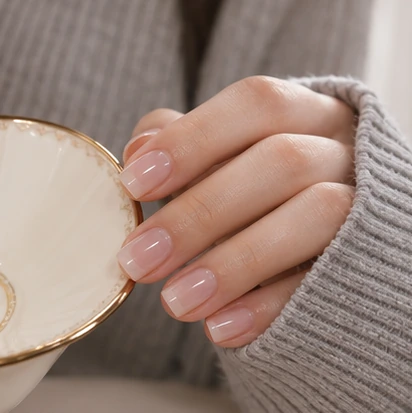
What the structured manicure is, and why it matters to press-on brands
A structured manicure is a salon service on the natural nail. Refinery29’s explainer, last updated on 22 May 2025, describes it as using a builder gel to create a long-lasting, durable enhancement, with an apex moulded at the highest part of the nail for balance and strength. Stylist’s 2022 guide to builder gel places it somewhere between regular gel polish and acrylics, thicker and harder-wearing than gel, usually in pale and pastel shades.
The look sits alongside a wider shift towards short, natural-looking nails. In February 2026 Hello! magazine reported that A-listers are ditching long acrylics for short, natural nails, with the micro French as the go-to short-nail detail. The Zoe Report’s summer 2026 trends, published on 15 May 2026, highlighted short almond nails, soft French and neutral chrome on milky bases.
These are fashion-press observations, quoted for context. There are no reliable public figures for how many press-on sets sell in a structured or minimal style, and we do not invent them. The useful insight for a brand is different: this customer wants a nail that looks like a good salon appointment, not an obvious stick-on. That raises the bar for tip shape, thickness and finish, which are all things you can specify.
What carries over to a press-on tip, and what does not
A salon structured manicure is built on the customer’s own nail. A press-on is a pre-formed tip in standard sizes. Some features translate directly; others need a workaround.
| Salon feature | In a press-on tip | How to brief it |
|---|---|---|
| Apex (raised high point) | Built into the tip’s curve and thickness, or added with a clear gel layer during finishing | Ask for a visible but soft apex; compare side-profile photos of sample tips |
| Thicker, “plump” surface | A thicker finishing layer over the tip | Specify the look; measure edge thickness on the sample and record it |
| Natural nail showing through | Not possible; the tip covers the nail | Use sheer nude, milky or tinted bases that imitate the effect |
| Short length on the customer’s nail | Short tip lengths in each size | Name the length per size or send a reference tip |
| Custom fit to each nail | Standard size runs | 24 pieces in 12 sizes, or 30 pieces in 15 sizes for more fit options |
| Three-week wear | Wear depends on adhesive, application and lifestyle | Run your own wear trial; do not copy salon wear claims |
Thickness and apex in a tip
This is where minimal sets succeed or fail. A plain sheer tip has nothing to hide behind, so its profile is the design.
Look at the side profile
Hold a sample tip side on. A structured look has a gentle rise from the cuticle area to a high point, then a smooth taper towards the free edge. A flat tip looks thin and cheap even with a perfect colour. A tip with a hump too close to the cuticle looks bulky and can lift at the base.
Measure, then specify
We do not publish target millimetre values, because the right figure depends on the material, shape and length you choose. Instead:
- Ask for two or three sample variations of the same design: a standard profile, one with a slightly stronger apex and one with a thicker finishing layer.
- Measure the thickness at the free edge and at the apex of the middle size with a simple calliper, and photograph each side profile against a plain background.
- Wear them and decide which looks right on the hand and still feels comfortable.
- Write the chosen measurements and photos into your specification so the production run can be checked against them.
Material matters
ORLA makes tips in ABS or acrylic, with an RCS recycled option where the certificate scope is confirmed per order. The two materials differ in feel and in how thin they can be made while staying stiff. Our ABS or acrylic guide explains the trade-offs.
Shape and length: a mix built around short
Minimal looks are usually short, but “short” covers different customers. A small mix of two or three shapes is enough for a first drop.
| Shape | Why it suits minimal | Watch out for |
|---|---|---|
| Short squoval | The closest press-on match to a natural, structured nail; practical for daily wear | Corners must be softened evenly on every size |
| Short almond | Elongates the finger; flattering with sheer bases and micro French | The taper must be symmetrical; a crooked point is very visible on short tips |
| Short oval | Soft and classic; easy for first-time wearers | Can look generic without a strong finish |
| Short square | Clean, graphic; suits fine lines and micro French | Sharp corners can catch; consider a squoval instead |
With short tips, fit shows more. A tip that is slightly too narrow leaves a visible gap at the side walls, and on a short, sheer nail there is nowhere for the eye to go except that gap. If your customers report fit issues, the 30-piece set in 15 sizes gives more in-between options. See the shapes guide for shape families and set sizes.
Sheer bases: harder than they look
Sheer nude, milky pink, soft white and jelly tints are the core of the minimal palette. They are also the bases that show manufacturing variation most clearly.
- Layer count changes colour. A sheer base gets darker or more opaque with each layer. Agree the layer count and approve the colour on a finished tip, not on a swatch.
- Bubbles and streaks show. On an opaque colour they are hidden; on a sheer base they are visible from the front.
- The tip itself shows through. Any moulding mark, cloudiness or uneven surface under a sheer base can be seen. Check tips before and after finishing.
- Batch drift is noticeable. Two batches of sheer pink that differ slightly will look different side by side in a customer’s drawer. Keep a retained reference set for each SKU.
The Japanese nails and glaze nails style pages show sheer and glazed bases that minimal designs often start from.
Micro French and fine lines
The micro French is a very thin tip line on a sheer or nude base; Hello! called it a paper-thin white line along the very tip. It looks simple and is one of the hardest details to repeat across a set.
- Scale the line to the size. A line that looks right on the thumb looks heavy on the little finger if its width stays the same. Ask the factory to scale line width with tip size, and check the smallest and largest sizes on the sample.
- Keep the curve consistent. On a short almond, the line follows the curve of the tip; on a squoval it is closer to straight. Specify which.
- Colour options. White is the classic; coloured micro French, chrome lines and double lines are variations. A Bustle feature in June 2026 quoted a nail artist describing thin, colourful French lines as an update on the classic tip.
- Fine line art. Single lines, dots and small negative-space shapes follow the same rule: consistent width, spacing and position across all sizes.
Our French nails page shows the classic version.
What to brief the factory
A minimal set has little decoration, so the brief must be precise about everything else. Use this as a template.
| Item | What to specify | How to check it |
|---|---|---|
| Shape and length | Short squoval, short almond, short oval or short square; length per size or a reference tip | Measure lengths on 3 sizes of the sample |
| Profile | Apex strength and edge thickness, with side-profile photos | Calliper and photo against your approved sample |
| Material | ABS or acrylic, or the RCS recycled option | Confirm on the quote and documents |
| Base colour | Physical reference or approved tip; layer count | Compare finished tips under daylight |
| Detail | Micro French width per size, curve, colour; line art position | Smallest and largest tips side by side |
| Top coat | Gloss, satin or matte | Even sheen across the set |
| Set | 24 pieces in 12 sizes or 30 pieces in 15 sizes | Count sizes in a sample of finished packs |
| Kit and packaging | Tips, glue, adhesive tabs, wooden stick, file, alcohol pad, or your own list | Check one packed set per SKU |
Every ORLA order is inspected before packing; give us the side-profile photos and colour references so the inspection checks what matters for this style. The quality and compliance page explains the steps.
Selling a set with almost nothing on it
A minimal set is harder to sell from a thumbnail than a bright or detailed design. The value is in the profile, the fit and the finish, so the listing has to show those.
- Show the side profile. One image of a worn nail shot from the side shows the apex and the taper, which is the whole point of a structured look. Use your approved sample for this shot, so the photo matches what production will deliver.
- Show it worn on more than one skin tone. Sheer bases change with the skin beneath them. A milky pink that looks soft on one hand can look chalky or grey on another.
- Name the length plainly. “Short” means different things to different customers. Give the length of a middle size in millimetres, measured on your own production sample, and say which shape it is.
- Explain the set. State the number of pieces and sizes and what is in the kit. Customers buying minimal sets often care about a clean fit more than about design, so the 30-piece, 15-size option is worth calling out.
- Keep claims modest. Do not borrow salon claims such as nail strengthening or three-week wear. A press-on sits on top of the nail and wear depends on application and lifestyle. Describe what you have tested.
Minimal sets also suit restocking well. With little seasonal decoration, a good sheer nude or milky squoval can stay in the range for a long time, which makes consistency between production runs the main quality risk. Keep the retained reference set and the profile measurements on file, and send them with every reorder.
Buyer example: a five-SKU minimal edit
Example only. “Plain Hand” is a fictional UK and US brand moving from nail polish into press-ons. Quantities are assumptions for illustration, not ORLA minimums or prices.
| SKU | Design | Shape | Set | First order (sets) |
|---|---|---|---|---|
| M1 | Milky pink, structured profile, gloss | Short squoval | 30 pieces, 15 sizes | 500 |
| M2 | Sheer nude with white micro French | Short almond | 24 pieces, 12 sizes | 450 |
| M3 | Sheer nude with chrome micro French | Short almond | 24 pieces, 12 sizes | 300 |
| M4 | Soft white, satin top coat | Short squoval | 24 pieces, 12 sizes | 250 |
| M5 | Sheer base with single fine black line | Short square | 24 pieces, 12 sizes | 200 |
Total: 1,700 sets. Plain Hand puts its main bet on M1 in the 30-piece set, because a short sheer nail shows poor fit more than any other design. It asks for three profile variations of M1 in the first sample round, wears them for a week, and writes the chosen edge thickness and side photos into its specification. M5 is the test: if line art sells, it adds a black version, drawing on our black designs guide.
Timing check: ORLA samples take 3 to 15 days and production 30 to 45 days after sample approval. Profile tuning usually adds a sample round, so plan for two rounds before you approve.
Next step: sample the profile, not just the colour
For structured minimal sets, request samples with two or three profile variations and judge them side on as well as from the front. Start on the samples page, compare finishes in the sample book, and choose between private label and OEM before sending a quote brief.